
Tennis Equipment Market Size to Reach $49.85 Billion by 2030 as Demand for Smart Connected Racquets and Sustainable Gear Gains Momentum – Mordor Intelligence
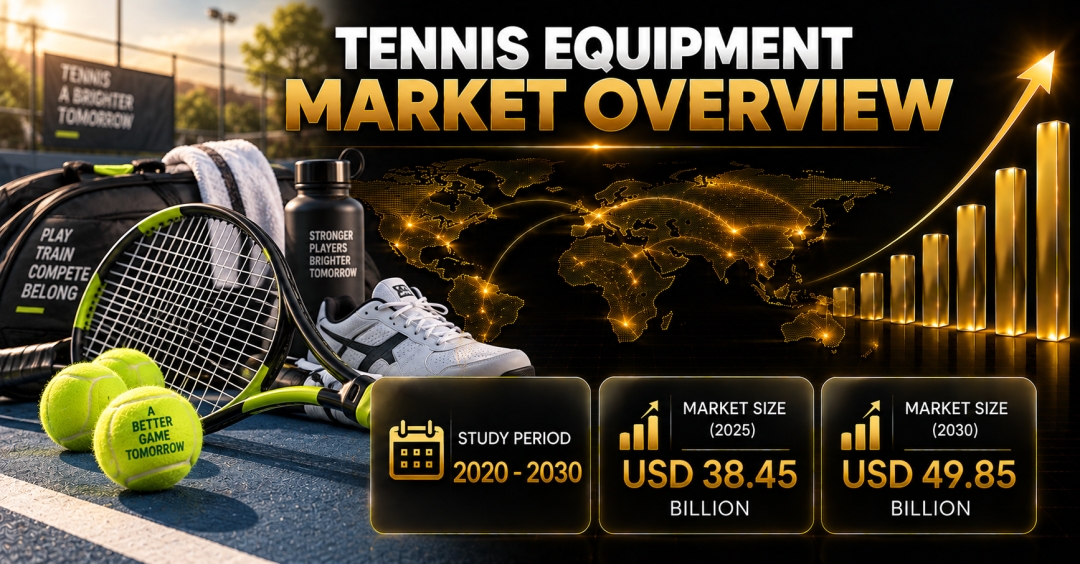
Hyderabad, September 17, 2026: According to Mordor Intelligence, the tennis equipment market size is estimated at $38.45 billion in 2025 and is forecast to reach $49.85 billion by 2030, reflecting a CAGR of 5.33% during the forecast period (2025-2030). The market continues to expand as recreational and competitive players seek high-performance gear that supports physical endurance, injury prevention, and court agility. Growing global tennis participation, continuous facility modernizations, and the rising popularity of racquet sports across diverse age demographics continue to support demand across sporting goods retailers, pro shops, and digital platforms worldwide.
The tennis equipment market growth is also influenced by expanding grassroots development initiatives and evolving consumer expectations regarding customized ergonomics and equipment durability. Sports gear manufacturers are investing in advanced composite materials, vibration-dampening structures, and sustainable fabrication methods. These developments are helping businesses respond to stricter sporting federation standards and consumer performance demands while maintaining lightweight maneuverability and aesthetic design. Together, these factors continue to strengthen the integrated tennis equipment market forecast across developed and emerging athletic markets.
Tennis Equipment Market Trends
Integration of Smart Sensor Technologies and Artificial Intelligence Supports Performance Tracking
One of the leading tennis equipment market trends is the integration of embedded sensors, micro-electronics, and AI-driven coaching systems into gear design. Connected racquets and smart training accessories capture real-time ball impact locations, swing speeds, spin rates, and stroke mechanics, transmitting data directly to mobile devices. This technical capability allows competitive athletes and dedicated amateurs to evaluate practice sessions quantitatively. The adoption of smart analytics and digital feedback systems continues to support the tennis equipment industry.
Sustainable Materials and Circular Manufacturing Gain Traction Across Gear Categories
While conventional carbon-fiber composites and virgin synthetics hold a dominant portion of the tennis equipment market share, sustainable product lines represent a rapidly expanding development space. Equipment brands are introducing racquets engineered with bio-based resins, recycled carbon fibers, and strings derived from post-consumer materials. Similarly, pressurized and non-pressurized tennis balls packaged in recyclable cardboard sleeves are replacing traditional single-use pressurized plastic cans. These manufacturing practices help brands align with broader ecological targets while maintaining rebound consistency and structural integrity.
Direct-to-Consumer Digital Platforms and Specialized Fitting Tools Expand Retail Reach
Another important tennis equipment market trend is the rapid development of direct-to-consumer digital channels and virtual racquet-fitting algorithms. Online platforms allow players to input physical attributes, swing styles, and court preferences to receive personalized equipment recommendations, string tension options, and grip sizing. Simultaneously, brick-and-mortar pro shops and specialty sporting goods stores remain central to the category by offering demo trial programs and on-site stringing services. Strategic multi-channel distribution alignments are becoming an essential area of competition across the tennis equipment industry.
Grassroots Youth Pipelines and Olympic Exposure Strengthen Global Participation
Demographic participation trends continue to play a significant role in the tennis equipment market growth. School physical education programs, community tennis clinics, and junior development pathways funded by national tennis associations are expanding the amateur player base. Furthermore, international tournament visibility and Olympic inspiration across countries such as the United States, China, and India are encouraging young players to take up competitive training. This steady influx of youth participants creates recurring replacement cycles for racquets, court footwear, and balls.
North America Maintains Revenue Leadership While Asia-Pacific Expands Fastest
Regional consumption patterns continue to influence the tennis equipment market forecast. North America remains the largest regional market by value, supported by extensive public and private court infrastructure, major tournament visibility, and high consumer spending on premium athletic gear. Meanwhile, the Asia-Pacific region represents the fastest-growing market as expanding sports investments, rising disposable incomes, and government-backed fitness programs drive athletic participation across urban centers. Evolving consumer lifestyle habits continue to create new opportunities for manufacturers expanding their regional presence.
Check out more details and stay updated with the latest industry trends, including the Japanese version for localized insights: https://www.mordorintelligence.com/ja/industry-reports/tennis-equipment-market?utm_source=abnewswire
Tennis Equipment Market Segmentation
By Product Type
- Racquets
- Balls
- Apparel
- Footwear
- Others
By End User
- Adults
- Kids
By Application
- Professional/Commercial
- Amateur/Personal
By Distribution Channel
- Online Retail Stores
- Offline Retail Stores
By Geography
- North America
- Europe
- Asia-Pacific
- South America
- Middle East and Africa
Competitive Landscape of the Tennis Equipment Industry
The tennis equipment industry exhibits a moderate level of market concentration, with established international sporting goods corporations, heritage racquet specialists, and technical performance footwear brands competing across material engineering, player endorsements, and global retail distribution networks. Market leaders are strengthening their market presence by developing proprietary frame geometries, upgrading footwear cushioning systems, and securing multi-year sponsorships with professional tour athletes to reinforce brand authority.
Frame aerodynamics, shock mitigation, and string bed engineering continue to be critical areas of differentiation as manufacturers invest in specialized graphite layups and elastomeric dampening layers to reduce arm fatigue. Businesses are also refining distribution partnerships with premier sporting retailers, tournament organizers, and tennis clubs to ensure prime product displays and trial opportunities. These initiatives are helping companies protect their tennis equipment market share while maintaining quality consistency across global consumer markets.
Regional expansion also remains an important business strategy. Leading equipment manufacturers continue to build strategic alliances with localized tennis academies, establish regional logistics hubs, and adjust price-point assortments to capture growing demand across both mature and high-growth markets. As global enthusiasm for racquet sports continues to rise, the tennis equipment market forecast remains supported by ongoing investments in advanced material science, digital retail integration, and international brand development.
Key Players
Major companies operating in the tennis equipment market include:
- Head Sport GmbH
- Amer Sports, Inc.
- Babolat VS SAS
- Yonex Co., Ltd.
- Sumitomo Rubber Industries
Conclusion
The tennis equipment market forecast remains positive as players of all skill levels continue choosing high-performance, durable gear that complements modern court strategies and active lifestyles. Equipment manufacturers and brand owners are responding by expanding smart training accessories, improving frame shock absorption, and adopting sustainable materials that balance athletic performance with environmental responsibility. These developments are expected to support continued demand across multiple commercial and retail channels.
Strategic channel optimization is becoming increasingly vital as companies adapt to changing direct-to-consumer shopping behaviors and player expectations regarding customized equipment setup. At the same time, specialized footwear traction systems and expanded youth development lines are helping businesses enhance overall product appeal while supporting long-term commercial goals. These structural developments continue to guide modern tennis equipment market trends.
Regional opportunities also remain strong. North America provides a reliable, high-value commercial baseline, while Asia-Pacific offers attractive growth pathways as tournament engagement and court construction accelerate daily tennis play. This shift is expected to create new commercial avenues for tennis equipment manufacturers expanding their operational footprint in developing markets.
Overall, the tennis equipment market size is expected to benefit from expanding global player participation, growing interest in data-driven athletic training, wider availability through modern digital and physical retail channels, and an ongoing commitment to equipment engineering. Together, these factors are expected to support sustained tennis equipment market growth while strengthening the long-term outlook for the global tennis equipment industry.
Industry-Related Reports
Golf Equipment Market: The global golf equipment market is expected to grow from USD 15.86 billion in 2026 to USD 20.27 billion by 2031, registering a 5.03% CAGR from its 2025 base value of USD 15.11 billion. Market momentum is supported by expanding recreational participation, rising global golf tourism, and substantial investments in indoor golf simulators and driving-range entertainment venues. Equipment manufacturers are prioritizing advanced lightweight alloys, multi-material clubheads, and high-performance custom-fitting technologies to capture higher-margin consumer demand across both mature and emerging markets.
Licensed Sports Merchandise Market Size: The global licensed sports merchandise market size is projected to expand from USD 44.99 billion in 2026 to USD 59.59 billion by 2031, advancing at a 5.78% CAGR from its 2025 valuation of USD 42.70 billion. Expansion is fueled by direct-to-consumer digital streaming platforms that widen global league followings and enable instantaneous, event-driven merchandise drops. To protect retail margins and eliminate counterfeit risks, integrated merchandise operators are scaling blockchain authentication systems while partnering with luxury fashion labels and prominent esports franchises to drive premium capsule sales.
Ball Sports Luggage Market Share: The global ball sports luggage market is estimated to increase from USD 3.45 billion in 2026 to USD 5.02 billion by 2031, growing at a 7.79% CAGR over the forecast period from its 2025 baseline of USD 3.20 billion. Category expansion is propelled by escalating household expenditures on youth athletic leagues, increased travel for regional tournaments, and substantial investments in Asian sports development across cricket and soccer academies. Sporting goods brands are differentiating through PFAS-free water-repellent coatings, circular recycled textiles, and multi-compartment ergonomic designs suited to modern mobile-first consumers.
About Mordor Intelligence:
Mordor Intelligence is a trusted partner for businesses seeking comprehensive and actionable market intelligence. Our global reach, expert team, and tailored solutions empower organizations and individuals to make informed decisions, navigate complex markets, and achieve their strategic goals. With a team of over 550 domain experts and on-the-ground specialists spanning 150+ countries, Mordor Intelligence possesses a unique understanding of the global business landscape. This expertise translates into comprehensive syndicated and custom research reports covering a wide spectrum of industries, including aerospace & defense, agriculture, animal nutrition and wellness, automation, automotive, chemicals & materials, consumer goods & services, electronics, energy & power, financial services, food & beverages, healthcare, hospitality & tourism, information & communications technology, investment opportunities, and logistics.
Media Contact
Company Name: Mordor Intelligence
Contact Person: Jignesh Thakkar
Email: Send Email
Phone: +1 617-765-2493
Address:11th Floor, Rajapushpa Summit, Nanakramguda Rd, Financial District, Gachibowli [email protected]
City: Hyderabad
State: Telangana 500008
Country: India
Website: https://www.mordorintelligence.com/industry-reports/tennis-equipment-market?utm_source=abnewswire


