
Thyroid Eye Disease Market Set to Witness Growth with Rising Awareness, Early Diagnosis, and Emerging Targeted Therapies by 2034 – DelveInsight | Immunovant Sciences, Viridian Therapeutics, Novartis
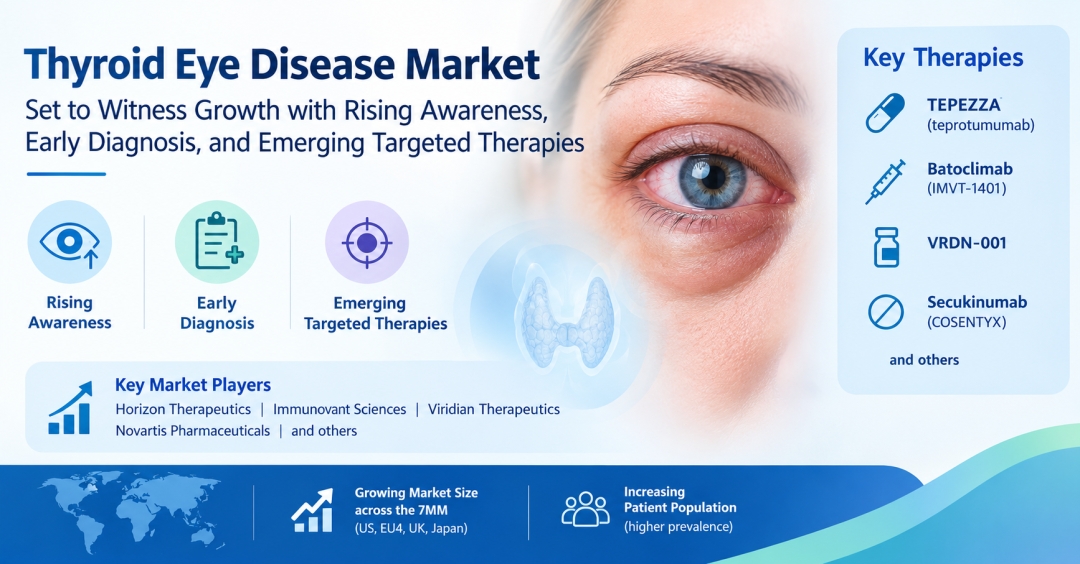
(Albany, US), October 08, 2026 – DelveInsight’s report “Thyroid Eye Disease Market Insights, Epidemiology, and Market Forecast – 2034” delivers an in-depth understanding of thyroid eye disease, presenting historical and forecasted epidemiology along with the thyroid eye disease market trends in the United States, EU4 (Germany, France, Italy, and Spain), the United Kingdom, and Japan.
The report examines current treatment practices, emerging drugs, and the market share of individual therapies. It also covers the current and forecasted 7MM thyroid eye disease market size from 2020 to 2034, the treatment practice/algorithm, and unmet medical needs, to curate the best of the opportunities and assess the market’s underlying potential.
Request a sample to explore the Thyroid Eye Disease Market Forecast: https://www.delveinsight.com/sample-request/thyroid-eye-disease-market
Some of the key facts of the Thyroid Eye Disease Market Report:
-
In June 2026: Viridian Therapeutics: The FDA approved Lumvoa (veligrotug-vvze) for thyroid eye disease, making it the first therapy labeled for both active and chronic disease. The approval strengthens competition with Tepezza and expands treatment options across TED stages.
-
In June 2026: Viridian Therapeutics: The U.S. FDA approved Lumvoa (veligrotug-vvze) on June 26, 2026, for thyroid eye disease, with labeling covering both active and chronic disease. The approval intensifies competition in the TED market and broadens patient access across disease stages.
-
In April 2026: Immunovant Inc.: Batoclimab failed to meet the primary endpoint in Phase III TED trials. The setback reduces Immunovant’s near-term competitive presence in TED and shifts focus toward other indications and pipeline candidates.
-
In 2022, the thyroid eye disease market size was the highest in the US among the 7MM, at approximately USD 1,980 million, and is expected to increase by 2034.
-
The total thyroid eye disease market size in the 7MM was approximately USD 1,993 million in 2022 and is projected to increase during the forecast period.
-
The total prevalence of thyroid eye disease in the 7MM comprised approximately 2,386,000 cases in 2022 and is projected to increase during the forecast period.
-
The US contributed the largest prevalent population, at around 1,012,000 cases in 2022 (~42% of the 7MM), while Germany accounted for around 13% and Japan around 8%.
-
According to DelveInsight estimates, there were around 16,300 cases of acute thyroid eye disease and 41,900 cases of chronic thyroid eye disease in Japan in 2022.
-
In the 7MM, approximately 20% of the patient share is attributed to males, whereas 80% is attributed to females.
-
Horizon Therapeutics’ TEPEZZA (teprotumumab) is the only drug approved by the US FDA for treating thyroid eye disease.
-
Until 2019, corticosteroids, immunosuppressants, and other biologics, including rituximab and tocilizumab, were the mainstay treatment options for moderate-to-severe acute thyroid eye disease, with a market size of approximately USD 37 million across the 7MM.
-
By 2034, among all the emerging therapies, the highest thyroid eye disease revenue is expected to be generated by batoclimab, followed by VRDN-001 and secukinumab in the 7MM.
-
Key Thyroid Eye Disease Companies: Horizon Therapeutics, Immunovant Sciences, Viridian Therapeutics, Novartis Pharmaceuticals, Sling Therapeutics, Regeneron Pharmaceuticals, ValenzaBio, and others.
-
Key Thyroid Eye Disease Therapies: TEPEZZA (teprotumumab), Batoclimab (IMVT-1401), VRDN-001, Secukinumab (COSENTYX), Linsitinib, Aflibercept, VB421, and others.
Thyroid Eye Disease Overview
Thyroid eye disease is an autoimmune inflammatory disorder associated with thyroid disease, which affects ocular and orbital tissues. It is also known as Graves’ orbitopathy, Graves’ eye disease, Graves’ ophthalmopathy, and thyroid-associated ophthalmopathy. It is the main extrathyroidal manifestation of Graves’ disease and is often disfiguring, significantly impairing the quality of life of affected individuals and causing great indirect and direct costs to health systems. Being an immune-mediated inflammatory disorder, it produces expansion of the extraocular muscles and fat in the orbit. Edema, accumulation of glycosaminoglycans and collagen, and adipogenesis cause most patients to enlarge both extraocular muscle and orbital adipose tissue.
To know in detail about the thyroid eye disease market outlook, drug uptake, treatment scenario, and epidemiology trends, Click here: Thyroid Eye Disease Market Forecast
Thyroid Eye Disease Diagnosis and Treatment Algorithm
Diagnosis of thyroid eye disease is complex because its symptoms overlap with other diseases, including inflammatory orbitopathies such as granulomatosis with polyangiitis, allergic conjunctivitis, and conditions seen in euthyroid and hypothyroid patients. Diagnosis is generally straightforward in thyrotoxic patients with bilateral proptosis, but it can be more difficult in euthyroid patients with unilateral proptosis. In these cases, the presence of thyroid autoimmunity, especially positivity of TSH receptor antibodies (TSI or TBII), is useful in establishing the diagnosis. CT scanning or MRI, with special attention to the orbits, can also help identify an orbital mass lesion, an infiltrative process, idiopathic orbital inflammation (pseudotumor), or other orbital abnormality. If imaging is compatible with thyroid eye disease, elevated TRAb helps make the diagnosis in a euthyroid patient. Timely and accurate diagnosis of acute disease is vital, as early intervention in the acute inflammatory phase may improve the long-term outcome.
According to the European Group on Graves’ Orbitopathy (EUGOGO) clinical practice guidelines 2021, IV methylprednisolone in combination with oral mycophenolate sodium (or mofetil) represents the first-line treatment for moderate-to-severe and acute thyroid eye disease. In the more severe forms, including constant/inconstant diplopia, severe inflammatory signs, and exophthalmos >25 mm, IV methylprednisolone at the highest cumulative dose (7.5 g per cycle) as monotherapy represents an additional valid first-line treatment.
Thyroid Eye Disease Epidemiology
The epidemiology of thyroid eye disease is not very well studied and understood, and most of the available secondary data is on incidence. The disease has an active inflammatory phase that lasts an average of 3–6 months but may be as long as 3 years, followed by a fibrotic inactive phase, and about 1% of patients experience reactivation after a period of inactivity. Prevalence therefore becomes the better parameter to understand the epidemiology of this disease. The epidemiology section of the report covers historical and forecasted epidemiology from 2020 to 2034, segmented by:
-
Prevalent cases of thyroid eye disease
-
Diagnosed prevalent cases of thyroid eye disease
-
Gender-specific diagnosed prevalent cases of thyroid eye disease
-
Moderate-to-severe drug-treated cases of acute thyroid eye disease
Key findings include:
-
The US contributed the largest prevalent population of thyroid eye disease, acquiring ~42% of the 7MM in 2022.
-
Among EU4 countries, Germany accounted for the largest number of cases, followed by France, whereas Spain accounted for the lowest number of cases in 2022.
-
The diagnosis and treatment rate of thyroid eye disease is expected to increase in the coming years due to expected approvals of several pipeline candidates, leading to greater awareness among patients and clinicians.
Download the report to understand which factors are driving thyroid eye disease epidemiology trends @ Thyroid Eye Disease Epidemiology Forecast
Thyroid Eye Disease Market Outlook
Thyroid eye disease treatment in the US is entering a new era with changing dynamics. To date, only one drug, the insulin-like growth factor-I receptor antagonist TEPEZZA, has been approved by the US FDA to treat the disease. The US market is expected to change substantially and grow, with TEPEZZA dominating it, while the launch of a second product, batoclimab, is anticipated in the coming 2–3 years. Considering that acute cases, around 20%, are the ones that get treated, the market is expected to expand, especially as safer and more effective therapies enter.
The current market has been segmented by commonly used drug classes based on the prevailing treatment pattern across the 7MM. Corticosteroids, immunosuppressants, neonatal Fc receptor antagonists, IL17A protein inhibitors, insulin-like growth factor-I receptor antagonists, and others (rituximab, tocilizumab, eye drops, painkillers, and supplements like selenium) are the major drug classes covered in the forecast model. Key companies such as Immunovant Sciences (batoclimab), Novartis Pharmaceuticals (secukinumab), Viridian Therapeutics (VRDN-001), Sling Therapeutics (linsitinib), Regeneron Pharmaceuticals (aflibercept), and ValenzaBio (VB421) are evaluating their lead candidates at different stages of clinical development.
The upcoming treatment landscape is poised for further expansion with new classes such as neonatal Fc receptor antagonists and IL17A protein inhibitors. The expected launch of upcoming therapies, greater integration of early patient screening, and an upsurge in awareness will facilitate the development of effective treatment options. However, since the condition is referred to as a rare indication, companies are charging premium prices, which often become a hindrance to adopting newer therapies. New thyroid eye disease companies have a huge opportunity to enter the market.
Discover more about therapies set to grab major thyroid eye disease market share @ Thyroid Eye Disease Treatment Landscape
Thyroid Eye Disease Drug Chapters
The thyroid eye disease drug chapter provides a detailed analysis of marketed drugs and late-stage (Phase III and Phase II) pipeline drugs. It covers clinical trial details, pharmacological action, agreements and collaborations, approval and patent details, the advantages and disadvantages of each included drug, and the latest news and press releases.
Marketed Thyroid Eye Disease Drugs
-
TEPEZZA (teprotumumab): Horizon Therapeutics
TEPEZZA (teprotumumab) is currently the only FDA-approved therapy for treating thyroid eye disease. It is a fully human IgG1 monoclonal antibody directed against the human insulin-like growth factor-1 receptor (IGF-1R), which is overexpressed in orbital fibroblasts and plays a vital role in thyroid eye disease inflammation. Significant improvements in proptosis, diplopia, and quality of life are noted following its 24-week course of therapy. It is supplied as a sterile, preservative-free, white to off-white lyophilized powder for IV infusion, and it showed a favorable safety profile. The reduction in proptosis is similar to that seen with orbital decompression surgery, which is associated with significant complications.
Emerging Thyroid Eye Disease Drugs
-
Batoclimab: Immunovant Sciences
Batoclimab (IMVT-1401) is a novel, fully human monoclonal antibody targeting the neonatal Fc receptor (FcRn), which has been observed to reduce IgG antibody levels. It is being developed as a self-administered subcutaneous injection and is being evaluated for severe autoimmune diseases mediated by pathogenic IgG, including thyroid eye disease. In an open-label, single-arm Phase IIa trial in 2019, four of seven subjects experienced a ≥2-point improvement in clinical activity score (CAS), and three of seven were proptosis responders. A Phase IIb trial was paused in February 2021 due to elevated total cholesterol and LDL levels in some subjects. The company then achieved alignment with the FDA Division of Ophthalmology and initiated two Phase III trials in the second half of 2022. As a novel mechanism-of-action drug, it can be a potential game changer in the treatment landscape, and its self-administered SC route could fulfill the unmet needs of an approved drug.
Key Factors Driving the Thyroid Eye Disease Market
-
Awareness Campaigns and Early Diagnosis: The 2020 approval of TEPEZZA and the company’s awareness campaigns for patients and clinicians are expected to increase early diagnosis and treatment of thyroid eye disease.
-
Emerging Therapy Pipeline: Promising candidates, including Viridian Therapeutics’ VRDN-001, Immunovant Sciences’ batoclimab, and Novartis’ COSENTYX (secukinumab), have the potential to create a significant positive shift in the market size.
-
Evolution Toward Targeted Therapies: Treatment has evolved from nonspecific immunosuppression to targeted biological therapies, with new classes such as neonatal Fc receptor antagonists and IL17A protein inhibitors expanding the landscape.
To know more about thyroid eye disease companies working in the treatment market, visit @ Thyroid Eye Disease Clinical Trials and Therapeutic Assessment
Scope of the Thyroid Eye Disease Market Report
-
Study Period: 2020–2034
-
Forecast Period: 2024–2034
-
Geographies Covered: The US, EU4 (Germany, France, Italy, and Spain), the United Kingdom, and Japan
-
Key Thyroid Eye Disease Companies: Horizon Therapeutics, Immunovant Sciences, Viridian Therapeutics, Novartis Pharmaceuticals, Sling Therapeutics, Regeneron Pharmaceuticals, ValenzaBio, and others
-
Key Thyroid Eye Disease Therapies: TEPEZZA (teprotumumab), Batoclimab (IMVT-1401), VRDN-001, Secukinumab (COSENTYX), Linsitinib, Aflibercept, VB421, and others
-
Thyroid Eye Disease Market Segmentation: By region/geographies and by drugs/therapies
Table of Content
-
Key Insights
-
Report Introduction
-
Thyroid Eye Disease Market Overview at a Glance
-
Executive Summary of Thyroid Eye Disease
-
Epidemiology and Market Methodology
-
Disease Background and Overview
-
Epidemiology and Patient Population
-
Patient Journey
-
Key Endpoints in Thyroid Eye Disease Clinical Trials
-
Marketed Therapies
-
Emerging Therapies
-
Thyroid Eye Disease: The 7MM Analysis
-
Market Access and Reimbursement
-
KOL Views
-
SWOT Analysis
-
Unmet Needs
-
Appendix
-
DelveInsight Capabilities
-
Disclaimer
-
About DelveInsight
Media Contact
Company Name: DelveInsight Business Research LLP
Contact Person: Abhishek kumar
Email: Send Email
Phone: 9193216187
Address:304 S. Jones Blvd #2432
City: Albany
State: New York
Country: United States
Website: https://www.delveinsight.com/


